
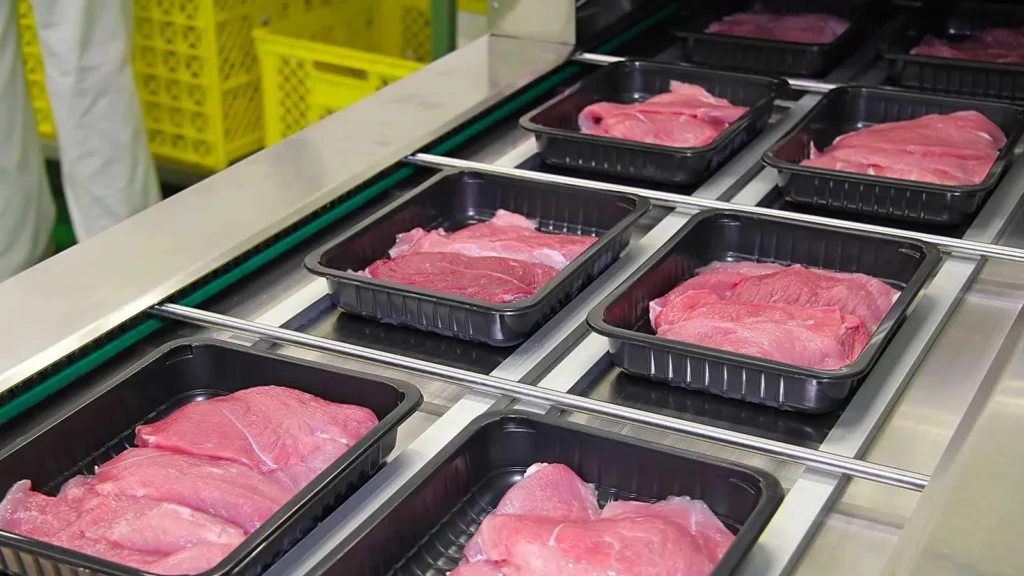
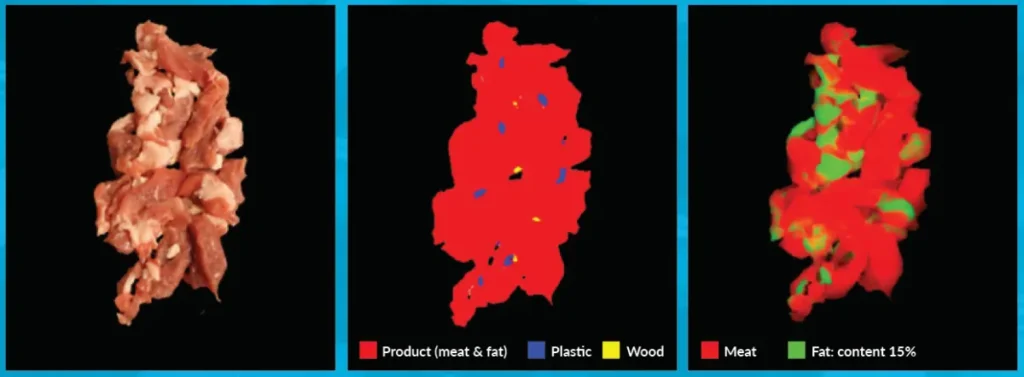
Improve your product’s quality and safety by defining meat’s chemical quality—such as lean/fat content, protein, water, and tenderness—while identifying and removing foreign materials like bone, cartilage, plastics, wood, rubber, metal, or parasites. Advanced hyperspectral imaging (HSI) modules can reveal significantly more than traditional color cameras, filter-based vision systems, or point spectrometers.
Raw meat, poultry, and fish carry a high risk of quality issues and contamination. Therefore, a reliable meat inspection process is a necessity to guarantee that products are high quality, safe, and in strict compliance with safety requirements.
Integrating industrial hyperspectral systems into your quality control and sorting processes enhances product inspection capabilities and real-time process analytics.
Key Benefits of Integrated HSI Systems
Implementing a fully integrated hyperspectral imaging system helps food processors to:
- Perform precise and reliable chemical grading and foreign material detection based on each material’s unique and distinctive spectral signature.
- Replace manual visual inspections and time-consuming laboratory tests with a non-invasive, real-time inline inspection.
- Cover 100% of the product stream on high-speed conveyor belts.
- Detect multiple characteristics simultaneously with a single sensor configuration—both for current metrics and future parameter updates.
- Avoid extra costs and penalties by consistently meeting legal prerequisites for fat, protein, and collagen ratios.
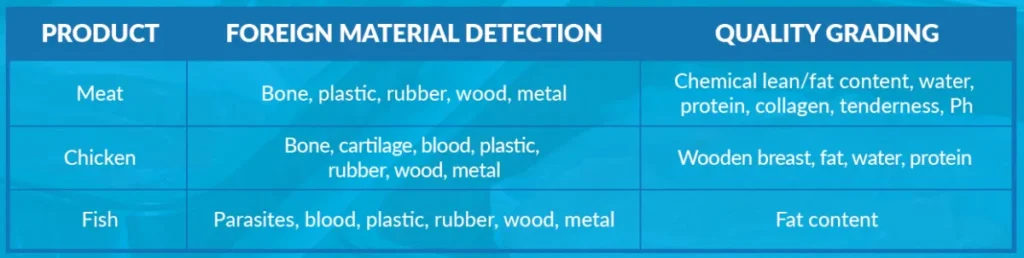
Figure: List of food quality parameters and foreign materials detected with hyperspectral imaging for meat, poultry, and fish processing.
Addressing the Pain Points in Your Production Line
Ensuring compliance and safety on high-speed processing lines is a critical challenge. Standard inspection systems often fail to identify moving contaminants accurately or generate false positives that halt production, leading to material waste and financial losses.
Our integrated hyperspectral imaging architecture was designed specifically to eliminate these headaches, operating continuously and in real time directly on industrial conveyor belts.
What We Solve in Practice:
- Uninterrupted Inspection: Instead of pausing production to collect samples and sending them for time-consuming laboratory tests, our system analyses 100% of moving products inline, identifying chemical anomalies instantly.
- Precision Against Changing Targets: Common static filter technologies struggle to process data from products that move or change positions rapidly, leading to unreliable readings and processing latency. Our unified integration utilizes continuous line-scan technology, ensuring every millimetre of the product is mapped with molecular precision, without slowing down your line.
- Optimised Illumination and Energy Efficiency: Another chronic factory floor issue is the need to maintain ultra-stable, homogeneous illumination over a massive surface area for cameras to read data accurately. Our solution focuses illumination and capture onto a single, narrow line, significantly reducing infrastructure costs and preventing scanning errors caused by ambient light fluctuations.
Conclusion
For processing facilities operating at high speeds that cannot afford errors in foreign material detection or fat-and-protein grading, choosing the right architecture is what separates profit from waste.
We deliver a unified, fully calibrated solution combining optimized hardware, robust processing software, and industrial-grade housing specifically engineered to break through inspection bottlenecks, ensuring maximum efficiency and total food safety compliance.