Food Processing:
Total Quality Assurance
Stop relying on random sampling and eliminate foreign material incidents while stabilizing key composition specs in real-time. We tune to your false-reject tolerance so throughput stays unchanged. Validated on your line during PoC.
Where We Act
Tailored Solutions for Every Segment of the Food Supply Chain
We deploy advanced near-infrared (NIR) and hyperspectral imaging (HSI) across multiple fronts to ensure 100% inspection, safety, and yield optimization.
Meat & Poultry Processing
Foreign material detection and composition grading.
Automate the detection of low-density contaminants that traditional X-rays miss—such as plastics, rubber, wood, paper, and cartilage. Simultaneously map fat-to-protein ratios, analyze connective tissue, and accurately predict meat tenderness and aging indicators to optimize product grading without destroying samples.
Slide to see beyond human sight

Dairy & Cheese Optimization
Real-time moisture, fat, and ripening control.
Monitor mozzarella lines and cheese-making processes inline to stabilize fat and moisture levels instantly. For laboratories and powder processing, our systems monitor powder consistency and composition (protein, lactose, solids, acidity) without reagents, ensuring batch consistency and maximizing yield.

Grains, Milling & Bakery
Mycotoxin screening and grain classification.
Replace slow, destructive lab tests with instant hyperspectral sorting. Automatically classify grain quality by identifying damaged, moldy, or fermented kernels, and run real-time screening for critical mycotoxins (Aflatoxin, DON, Ochratoxin) directly on the sorting line or during blending.

Slide to see beyond human sight
Seafood Quality Control
Color consistency, trim, and defect mapping in fish fillets.
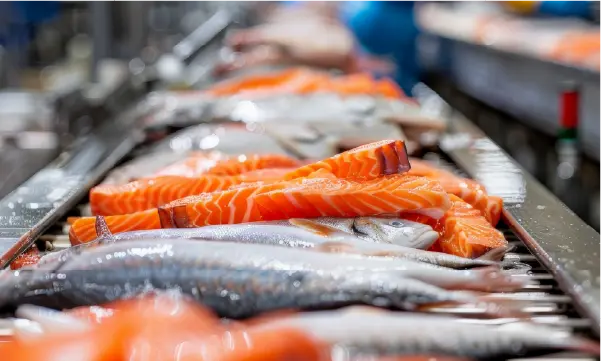
Ensure pristine product aesthetics and safety. Our imaging solutions specialize in quality, trim, and defect profiling—accurately mapping color distribution, fat/moisture consistency, and tissue gaping in salmon and whitefish fillets. When required, specialized models for bone and spine detection can be deployed and validated for your specific use case during PoC-90.
Advanced Packaging Inspection
Non-destructive seal integrity.
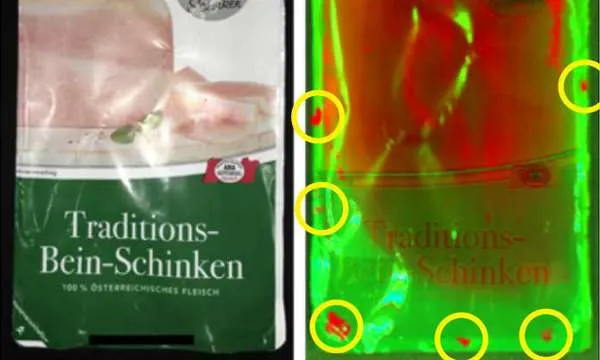
Inspect modified atmosphere packaging (MAP) and thermoformed seals directly on the high-speed conveyor. Detect product-in-seal defects or foreign materials through printed films without puncturing the package or slowing down throughput.
How We Integrate
Hardware Built for the Production Floor
From the receiving dock to the final packaging line, our technology fits seamlessly into your existing operations.
Inline & On-Line Process Sensors
Designed for harsh industrial environments. Our process modules feature rugged, washdown-ready enclosures, ATEX explosion-proof compliance (where required), and optional cooling systems for extreme temperatures. Install them directly on blenders, fluid beds, pipes, and high-speed conveyors.
Benchtop Laboratory Systems
Fast, reliable, and completely reagent-free. Accelerate your QA lab throughput with instant verification of incoming raw materials or finished products, completely eliminating sample preparation or chemical waste.
Handheld Portable Devices
Bring the lab to the receiving dock. Our ultra-portable NIR spectrometers connect directly to smartphones and cloud architecture, allowing field managers or auditors to perform real-time chemical composition checks anywhere—even without internet connectivity.
Why Spectral Solutions?
Why Hyperspectral Imaging Beats Traditional Inspection
Standard RGB cameras only see surface color. X-rays only catch high-density materials. Spectral Solutions unlocks the invisible spectrum.
X-Ray
- Fails at color identification
- Misses low-density materials
- High energy consumption
Spectral HSI
- Contactless detection
- Handles color interference
- Quantitative + qualitative analysis
Standard RGB
- Blind to chemical composition
- Cannot see internal defects
- Surface color only
Defect Detection Accuracy
Spectrum Coverage
Moving Parts
Frequently Asked Questions
X-ray separates objects by density, so low-density contaminants pass straight through it. Hyperspectral imaging maps chemical composition instead, which is how it finds plastic, rubber, wood, paper, cardboard and cartilage that both X-ray and standard RGB cameras miss. It inspects the entire product stream on the belt at line speed, not a sample of it.
Hyperspectral inspection images every unit passing on the belt, so coverage goes from roughly one sample every few minutes to the entire production stream. That changes what a quality record can state: instead of inferring a lot's condition from a sample, the line holds a per-unit result for the whole lot.
Inline NIR on a mozzarella or cheese line reads fat and moisture continuously, so the process is held at target instead of corrected after the vat. In powder processing the same sensor tracks protein, lactose, total solids and acidity. Because the same models run on inline, benchtop and handheld units, a plant can begin with at-line checks and move the measurement into the process later.
Yes, both in line and at line. NIR over a grinder or conveyor reads fat, protein and moisture on the moving product, so a blend is corrected toward its target fat percentage during production rather than reworked afterwards. A handheld unit gives the same measurement on a grab sample in 5 to 10 seconds, which is how most plants start before committing to an inline installation.
For the parameters a NIR calibration covers — moisture, protein, fat, ash and carbohydrate by difference — a calibrated instrument produces composition in-house for every new batch or SKU. The same models run on benchtop and handheld units, so the check can sit in the quality laboratory or on the production floor. The values behind an FDA Nutrition Facts panel are still confirmed by the reference method.
No. Hyperspectral and NIR systems are non-contact and non-destructive, and they are specified to the line's existing speed rather than the line being slowed to suit the sensor. What needs tuning is the false-reject rate: the system is set on the plant's real product during the proof of concept, so throughput and giveaway both stay where they are.
Composition and surface contaminants are its strength. It does not replace metal detection for dense metal fragments, it does not perform microbiological testing, and it reads the product surface rather than the interior of a dense opaque block. Contaminants at microgram-per-kilogram levels remain a reference-laboratory measurement. Systems are normally specified alongside metal detection, not instead of it.
