Packaging & Sealing:
Integrity Without Compromise
Protect your brand from recalls by detecting micro-leaks and contamination under printed, opaque, or sustainable films. Inspect every package inline at full production speed, validated on your line during PoC-90.
Where We Act
Defend Your Shelf-Life and Seal Integrity in Real-Time
Standard vision systems are blind to what lies beneath the surface. Our hyperspectral imaging (HSI) technology penetrates barrier layers instantly, inspecting every single package at maximum line velocity
Product-in-Seal Contamination Detection
Eliminating late-stage seal failures caused by trapped materials
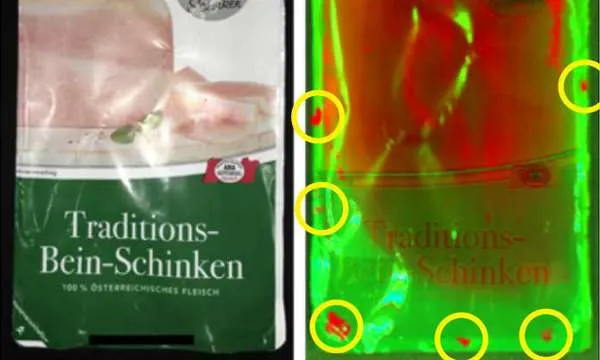
Prevent the leading cause of channel leaks. When food particles, fats, oils, or powders get trapped between packaging films during high-speed clamping, the seal is compromised. Our HSI sensors analyze the unique chemical signatures of your product vs. the polymer matrix, flagging hidden product-in-seal defects instantly before the batch leaves the factory floor
inspection Through Printed, Metallic & Opaque Films
Full-spectrum visibility through branded wrappers and complex graphics
Brand marketing demands complex, heavily inked, or metallic graphics—all of which blind conventional RGB cameras. Spectral NA's hyperspectral technology operates in the short-wave infrared spectrum, passing directly through superficial printed artwork to evaluate the physical bond of the seal beneath. If there is an air pocket, micro-leak, or misalignment, we catch it
Sustainable & Eco-Friendly Substrate Validation
Securing reliable seal boundaries on modern alternative films
Transitioning to plant-based, compostable, thinner, or recycled substrates presents massive thermal challenges, as these eco-friendly materials have narrow, volatile sealing temperature windows. Our inline monitoring systems continuously gauge molecular molecular consistency across the seal area, ensuring your sustainable packaging initiatives don't result in increased product spoilage or fragile seal boundaries.
MAP (Modified Atmosphere Packaging) Verification
Protecting gas flushing metrics and extending product shelf-life
For fresh meat, cheese, salads, and bakery products, a micro-leak means immediate nitrogen loss, premature oxygenation, and rapid bacterial growth. We validate your thermoformed trays and flow-wraps inline. By deploying systems engineered to detect micro-leaks and seal contamination beyond pressure sampling, we ensure your gas barrier holds perfectly, validated to your defect thresholds during PoC-90
How We Integrate
Seamless Retrofitting for High-Speed Packaging Lines
No slowdowns. No redesigns. Our hardware mounts directly onto your existing equipment, operating at full automated velocity
Flow-Wrapper & VFFS Inline Integration
Engineered to fit directly over the discharge conveyor or immediately after the rotary sealing jaws of your horizontal flow-wrappers and vertical form-fill-seal machines. The solid-state architecture captures continuous data matrices without requiring the product to stop or index
Multi-Lane Tray Sealer Arrays
We eliminate buying friction. Under our strict PoC-90 program, we install our hyperspectral equipment directly into your production line for 90 days. We tune the optical AI to your exact film substrates and false-reject tolerances, proving inspection efficacy under true operational stress before you commit to capital expenditure
The PoC-90 Framework (Proof of Concept)
We eliminate buying friction. Under our strict PoC-90 program, we install our hyperspectral equipment directly into your production line for 90 days. We tune the optical AI to your exact film substrates and false-reject tolerances, proving inspection efficacy under true operational stress before you commit to capital expenditure
Why Spectral Solutions?
Why Hyperspectral Systems Excel Where RGB Vision Fails
If your packaging inspection relies on standard cameras or manual spot-checks, you are exposed to hidden liabilities
Standard RGB Vision
- Blinded by printed films
- Relies on color contrast
- Misses hidden seal defects
Spectral HSI
- Penetrates barrier layers instantly
- Maps distinct chemical compositions
- 100% full line speed
Manual Spot-Checks
- Samples only 0.5% production
- Destructive testing methods
- Allows micro-leaks to escape
Non-Destructive Inspection
In-Line PoC Program
Throughput Bottleneck
Frequently Asked Questions
Hyperspectral imaging inspects the seal zone as the pack is formed and identifies grease, oil, powder, sauce or product fragments caught between the films — the most common cause of leak channels in flow-wrapped and thermoformed packs. Because it maps chemical composition, it distinguishes a contaminated seal from a printed graphic or a normal fold in the film.
Yes. Spectral inspection reads the seal at infrared wavelengths, where many films that block a standard color camera are effectively transparent, so branding, dark graphics and metallized layers do not hide what is trapped in the seal. This is the practical difference from conventional vision inspection, which can only judge what the printed surface lets it see.
Yes, and it is often what makes the switch to those films viable. Sustainable substrates seal within a narrower process window than the multilayer films they replace, so seal defects rise during changeover. Spectral inspection gives per-pack verification while the sealing parameters are being requalified, instead of the problem surfacing later through returns.
The camera is mounted over the existing web or conveyor with no change to the sealing machine itself, and rejects are handled by the line's existing reject mechanism. Multi-lane tray sealers are covered by an array across the lanes. The integration is mechanical mounting plus a reject signal, not a rebuild of the packaging machine.
By tuning the model on the plant's own packs and its own defect definitions before go-live. The threshold between a cosmetic variation and a genuine reject is a commercial decision, not a fixed setting, so the proof of concept establishes it against real production — including the normal variation that should never trigger a reject.
100%, at full line speed. Manual or destructive seal testing typically covers well under one percent of production, which means a seal problem is found packs — often pallets — after it began. Continuous inspection turns that into an immediate reject and an alarm at the sealing station while the problem is still measured in seconds.
